
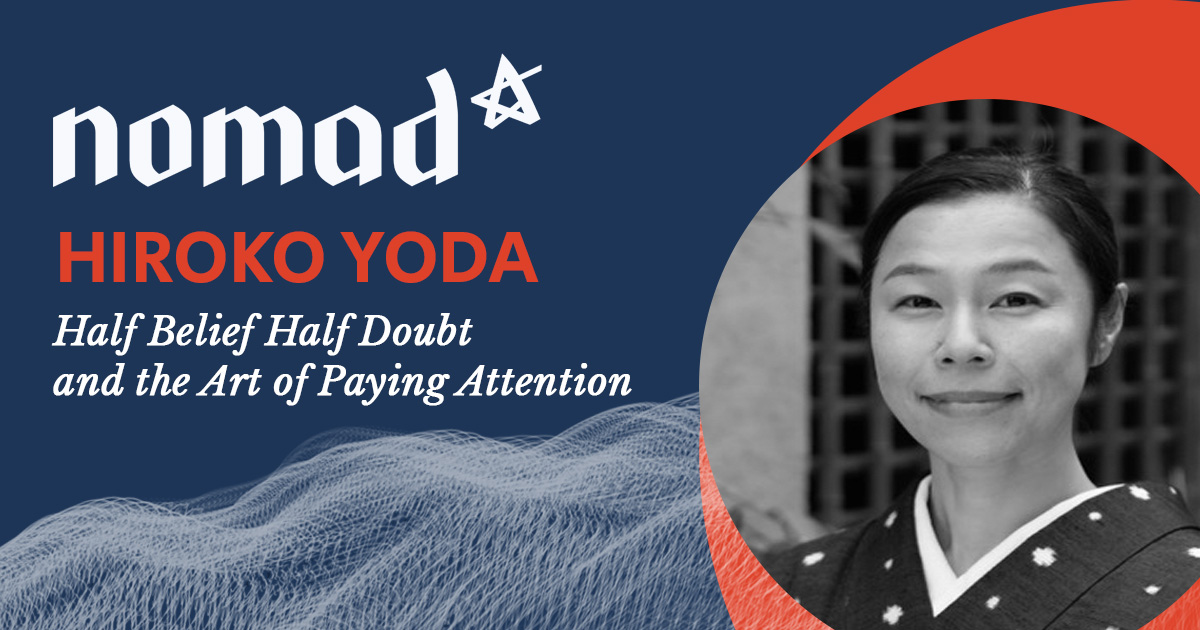
In this gentle and quietly unsettling conversation, Hiroko Yoda invites us into a world where spirituality doesn’t begin with belief, but with attention. Drawing on her Japanese upbringing and her book Eight Million Ways to Happiness, Hiroko reflects on grief, ancestors, everyday ritual, and the idea of “half belief, half doubt” — a way of living that makes space for ambiguity rather than trying to resolve it. From small shrines in city parks to the simple act of taking a walk, she describes spirituality as a set of tools for pausing, noticing, and staying connected to the living world around us.
Together, Tim and Hiroko explore what happens when faith becomes less about certainty and more about participation: how joy and play find their way into sacred spaces, why traditions can be blended and remixed without anxiety, and what it might mean to belong without needing to define what you believe. It’s a conversation that gently challenges Western ideas of religion and invites listeners to experiment with a slower, softer, more attentive way of being in the world.
Following the interview, Nomad hosts Tim and Anna reflect on the disorientation and gift of meeting a spirituality that doesn’t play the same “belief game,” exploring simplicity, attention, and the idea of spiritual practices as tools rather than tests.
Interview starts at 17m 53s
WEBSITE
SOCIALS
BOOK
Eight Million Ways to Happiness: Find Your Own Way to Inner Peace with the Wisdom of Japan
QUOTES
“Japanese spirituality is hiding on plain sight. Never be evangelical. Never be pushy. It’s just there.”
“The belief doesn’t really matter. It’s more like, just we do.”
“In Japan, religions are not dogma. We can freely move in and out without any commitment.”
“Japan is very rigid in society, but very flexible in spirituality.”
2 Responses
I enjoyed this conversation so much, thank you! I felt there was a playfulness to Japanese spirituality that appealed to my way of being and practicing. One that gave me space and removed “rules” that many other religions or religious practices impose. It felt immediately familiar and safe and I felt somehow that I also practice Japanese spirituality… which makes me laugh and smile as I am not Japanese and have never touched feet on Japanese soil. But I felt a kindred spirit in Hiroko’s approach to life and spirituality because I have picked up spiritual practices from around the world, as I have lived in Asia, Europe and the Middle East. Being a third culture kid and having been raised in a number of different countries, there is a similar feeling when you meet another third culture kid or “global nomad”. One feels a sense that you have met kin in those moments and I had that feeling listening to Hiroko. Thank you sister for sharing your practices, love and joy with us! Thank you Tim for bringing her to us.
It was pleasure Zoe, glad you enjoyed it. Tim