
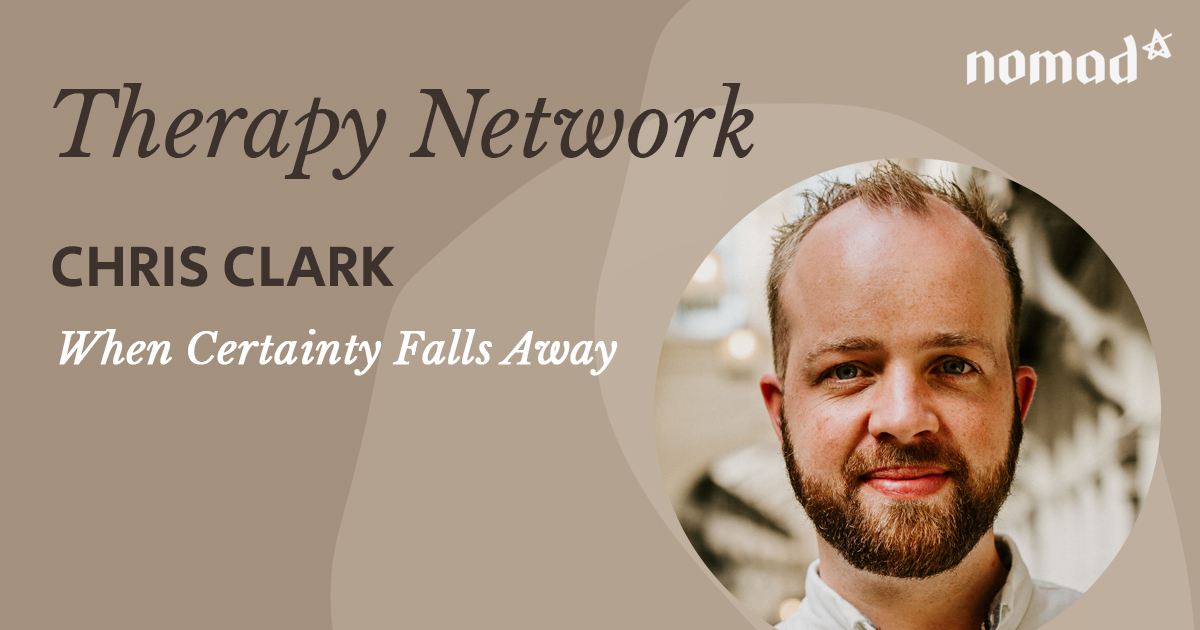
Chris Clark – When Certainty Falls Away
I don’t remember a single moment when my faith unravelled, but I do remember certainty becoming harder to hold.
For much of my life, my Christian faith gave me a foundation for understanding the world. It shaped what I believed was right and wrong, what was safe and dangerous, and what it meant to live well. It also offered something many people are drawn to – answers and certainty; a sense that the most important questions in life already had answers.
Over time, I found myself drawn to questions that didn’t sit easily within that worldview. They didn’t all arrive at once, and they weren’t always dramatic. Often they emerged gradually – through experience, relationships, and a growing awareness of the gap between what I believed and what I was living.
Training as a therapist gave me a different kind of space to think about these questions. Like opening a door I hadn’t realised was unlocked, I found language for things I had carried throughout my life but hadn’t been able to articulate. No longer was this simply a question of belief; it became a journey of learning how to relate to myself.
There came a point where the contradiction between my Christian faith and my lived experience could no longer be tolerated. I remember describing that moment, somewhat bluntly, as “giving up on God.” It wasn’t quite accurate, but it was the closest language I had at the time. Looking back, I don’t think I was giving up on God as such. I was letting go of a particular understanding of God – one shaped by the context I was part of. It felt less like losing faith, and more like stepping out of the story I had been living in, without yet knowing how to tell a different one.
That space in between, where certainty loosens with nowhere new to land, can be a difficult place to arrive. There is often a pull to seek answers, to reconstruct belief in a way that restores clarity and stability. But equally, we need ground to stand on, even if it isn’t as firm as the certainty we once knew.
What I’ve come to value is the capacity to hold things more gently and lightly – not necessarily a rejection of faith, but a different way of relating to it.
The loosening of certainty has also shaped how I think about personal wellbeing. One area where this becomes particularly visible is sexuality. In my clinical practice, the people I work with describe receiving clear messages about where sexuality belongs and how it should be expressed. These messages are often framed as moral or theological truths, but they are rarely limited to belief alone. They are absorbed.
They shape how we relate to our bodies, our sense of desire, and how we feel about making choices we can live with. In my work, I am less interested in whether a belief is right or wrong. I’m more interested in how the person relates to the belief.
Does it allow you to be curious, or does it shut it something down?
Does it help you make your own choices, or does it hold you back?
Does it help you connect with yourself, or does it require you to reject your experience?
These are not easy questions to ask, especially when certainty is so closely tied to belonging. Christian communities, like any cultural group, offer both support and constraints. They provide meaning, connection, and identity, but they also shape what feels true and safe, what can be spoken, and what is better left unsaid.
I’ve come to understand that culture is not just what is taught, but what is internalised by the body. In my experience, people are often more aware of this than they are able to articulate. There is a gap between what is permitted to be thought and felt, and what is actually experienced. Sadly, when that gap is named within a Christian community, it is often redirected in a way that avoids discomfort and retreats to what is already believed and accepted.
Over time, this can make it harder to trust your own experience – to trust yourself. And as certainty begins to fall away, that tension becomes increasingly difficult to ignore. For some people, this leads to a reworking of faith. For others, it leads to stepping away. But for most, it involves a period of not knowing – of living without the certainty that was once relied upon.
What I’ve come to see is that this journey is not just about loss, but the beginning of something more grounded and alive. I also don’t want to pretend this is about finding new answers. It’s more about relating to the questions differently, allowing for complexity, rather than quick resolution, and holding space to consider faith and uncertainty as complementary rather than oppositional.
As a therapist, I’m not seeking to lead anyone toward any particular conclusion, but I offer a space where these questions can be explored intentionally and safely.
Whether you are questioning, leaving, or reimagining your faith, the process can feel isolating and destabilising. Having somewhere to reflect, feel, and speak openly about that can make a real difference – a space to stay with what is emerging, rather than rushing to resolve it.
– Chris Clark